Where AI shines in new product development
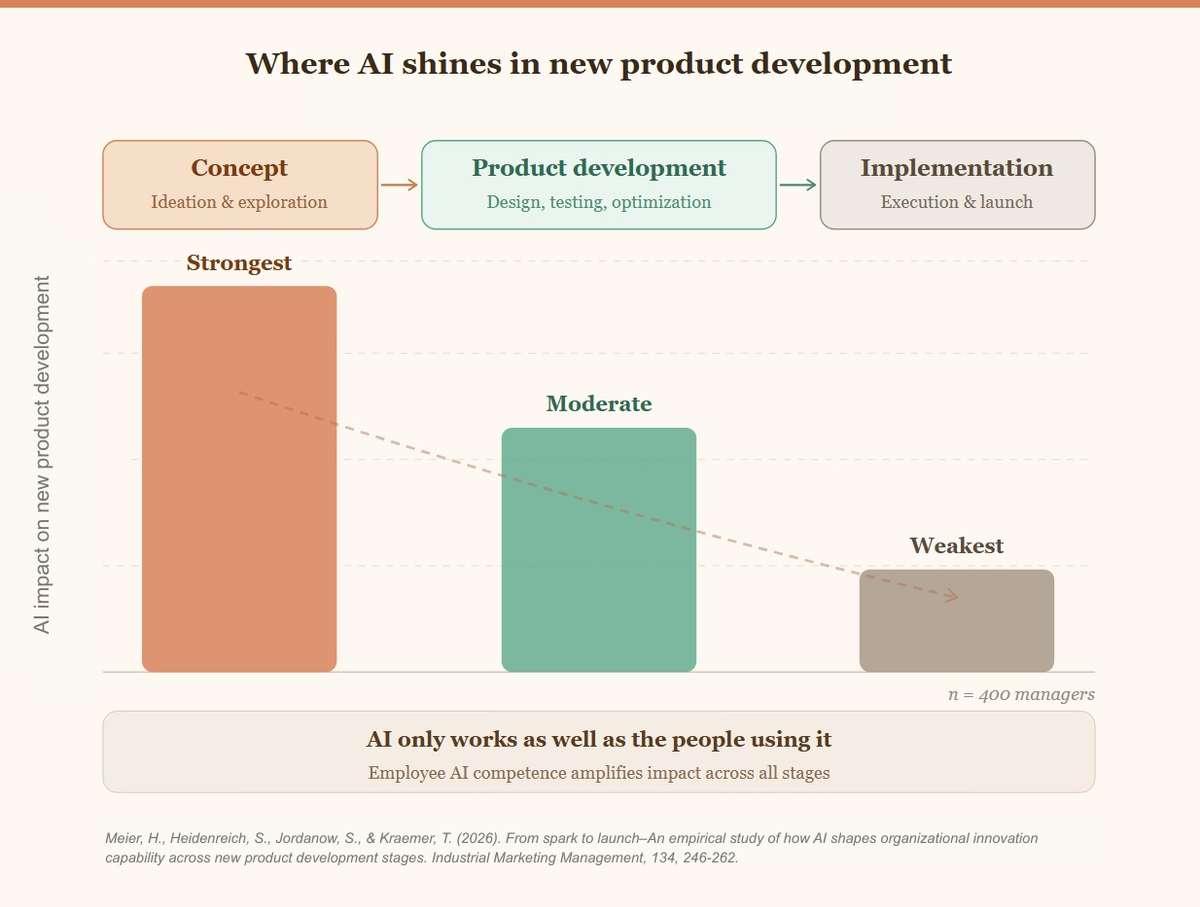
AI does not improve every stage of new product development equally according to a new research of 400 managers.
The study looked at how AI affects innovation across three stages:
Concept development → Product development → Implementation
The pattern is clear...and uneven.
AI has its biggest impact at the very beginning.
In concept development, it excels at generating ideas and in processing large amounts of unstructured data. The gains are significant. As you move forward, the impact fades.
In product development, AI still helps with design, testing, and optimization, but its contribution is smaller. Human expertise becomes more important as ideas get more concrete.
By implementation, AI's impact is weakest of all. Execution, relationships, and judgment still belong to people.
AI is not a uniform productivity tool. Its value depends on where you deploy it.
But there's also a valuable second finding:
AI only works as well as the people using it.
Companies that invest in AI tools without investing in skills capture far less value.
The research shows that employee AI competence significantly amplifies the impact across all stages.
What does research suggest about building AI capability inside firms?
A growing body of research in information systems, innovation, and management points to a consistent set of levers.
First, formal training matters, but only when it is task-specific.Research on IT and AI capability development (Chakravarty et al., 2013; Mikalef et al., 2023) shows that generic training has limited impact. What works is training tied to real use cases—such as prompting models for idea generation or using AI in product design workflows. Capability develops faster when learning is embedded in actual work.
Capability is built through use, not instruction. In new product development, experimentations are critical, and AI can dramatically reduce the time they take (going from months to minutes!) (Marion et al., 2025). Employees learn by iterating, testing outputs, and refining inputs. Over time, this creates a kind of practical intuition that cannot be taught in a classroom.
At the same time, AI capability is not purely a technical skill. Research on knowledge integration (Pavlou & El Sawy, 2006) shows that value emerges when technical expertise and domain knowledge are combined. AI specialists may understand the tools, but business teams understand the problems. Capability develops when these perspectives come together, not when they operate in isolation.
Finally, capability does not depend on people alone. Even highly skilled employees cannot create value without the right infrastructure. Access to high-quality data, usable tools, and integrated systems is what allows individual skills to translate into actual outcomes.
Taken together, these findings point to a broader conclusion. AI capability is not built through isolated training programs or technology investments. It emerges from the interaction between learning, experience, collaboration, and infrastructure.
Firms that understand this do not just adopt AI faster, but learn how to use it better.
References:
Chakravarty, A., Grewal, R., & Sambamurthy, V. (2013). Information technology competencies, organizational agility, and firm performance: Enabling and facilitating roles. Information systems research, 24(4), 976-997.
Chen, A., Wang, Y., Lu, Y., & Liu, Y. (2026). Turning skepticism into engagement: understanding high-skilled users' acceptance of AI translation. Industrial Management & Data Systems, 1-23.
Marion, T., Yuan, C., & Moghaddam, M. (2025). Integrating AI into the Front End of New Product Development: A Case Comparison of Traditional and Augmented Processes. Research-Technology Management, 68(2), 10-22.
Meier, H., Heidenreich, S., Jordanow, S., & Kraemer, T. (2026). From spark to launch–An empirical study of how AI shapes organizational innovation capability across new product development stages. Industrial Marketing Management, 134, 246-262.
Mikalef, P., & Gupta, M. (2021). Artificial intelligence capability: Conceptualization, measurement calibration, and empirical study on its impact on organizational creativity and firm performance. Information & management, 58(3), 103434.
Pavlou, P. A., & El Sawy, O. A. (2006). From IT leveraging competence to competitive advantage in turbulent environments: The case of new product development. Information systems research, 17(3), 198-227.